

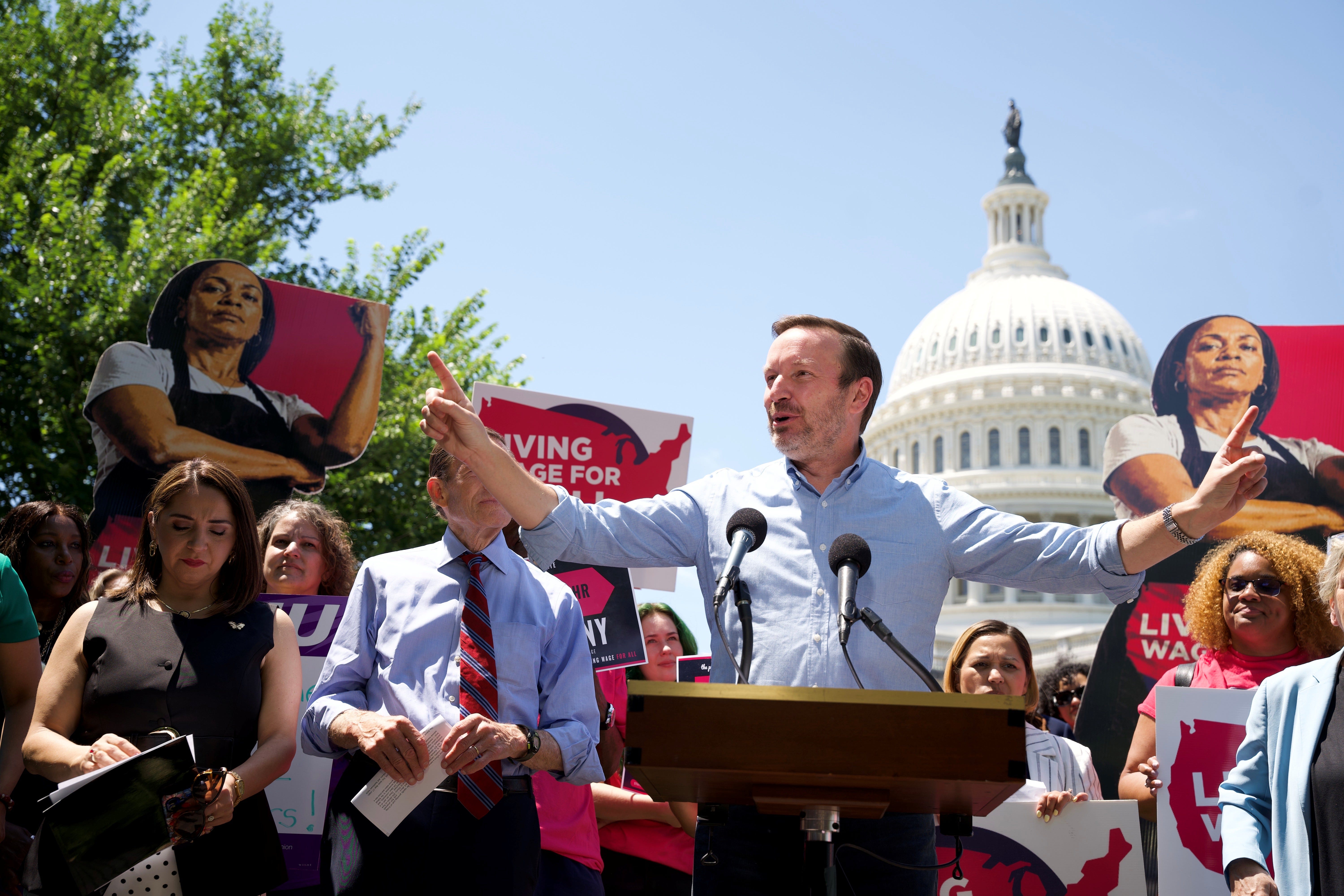
Photo credit: OFW member and photographer Nortei Dowuona.
Every year for the last decade, I’ve walked across Connecticut. It takes me about a week. I know it might sound a little quixotic: a U.S. Senator walking down Main Streets and country roads, stopping to talk to whoever might pass by. But there’s a reason I do it.
I started walking because I was worried I might confuse the echo chambers on cable news and Capitol Hill with the actual country. That if I only heard the loudest voices in our politics, I’d forget what normal, decent people actually feel.
So the walk is my annual reset.
A few years back, I met a man named Izzy. We crossed paths in Willimantic as he was leaving a liquor store on Main Street, six-pack in hand. He told me it was his ritual — his way of breaking up the monotony of the day.
Life hadn’t turned out as he’d hoped. He had once lived in New York City, with a career he was proud of and a wife he loved. But her death unmoored him. Heartbroken, he eventually moved to Connecticut to be closer to family. To make ends meet, he got a job at Walmart.
Izzy told me he was proud to work for an iconic American company. He was loyal to Walmart. He gave them seventeen years of his life.
But Walmart was not loyal to him. The job he’d clocked into day after day, year after year, paid little more than minimum wage. Instead of a pension, Walmart offers a 401(k) plan, but like nearly half of Walmart employees he was paid too little to save anything in it. So, after he stopped working, he was forced to survive on his Social Security check and food stamp allowance.
So now, Izzy was spending what should be his golden years in a cramped apartment with two strangers he found online. He can afford little more than his rent and that ritualistic six-pack. “Sometimes,” he told me, “my life doesn’t even feel human.”
That line has stuck with me ever since, because it tells the whole story. Izzy played by the rules. But the rules had been written by someone else, for someone else.
Let me explain.
In 1970, America’s largest private employer was General Motors. Average wages there were $34 an hour in today’s dollars. Employees got a pension and good health care. The CEO, meanwhile, made about 60 times the average worker.
Now let’s be clear: That time was far from perfect. But it’s worth remembering that in the not-too-distant past, a career at an iconic American company like GM brought more than just a paycheck. It provided a dignified life where a worker could buy a home, start a family, put some money away for retirement. Maybe a family trip every once in a while. Working people didn’t expect to live a lavish life. Just one with some security.
But for those at the top, apparently even that was too much for workers to ask. So corporate America rewrote the rules. Instead of prioritizing a fulfilled and productive workforce, and the wellbeing of the communities they called home, companies went all in on enriching shareholders. As they waged all-out war on unions, they redirected profits toward stock buybacks and executive compensation.
Their craven project worked exactly as intended.
Today, America’s largest private employer is the same one that employed Izzy. The average Walmart worker makes just over $15 an hour. Less than half, in real spending power, of what GM workers made in the 70’s. There is no pension.
It’s not like there’s less money to go around. What changed is where that money is going. Walmart’s CEO makes nearly 1,000 times the average worker’s pay. Meanwhile, the heirs to the Walton family are worth around $500 billion altogether.
This isn’t just a Walmart story. It’s the story of our economy these last forty years.
American workers are 92 percent more productive than they were in 1979, making their companies more profitable than ever. But in that same time, their wages — how they share in the gains of that productivity — have grown by less than 34 percent.
Profits that once flowed down to workers are now siphoned up to shareholders and corporate executives — the ultra-rich who then scapegoat immigrants, or China, or some other boogeyman as the real reason their workers can’t make ends meet.
And Congress has let them get away with it.
We’ve watched the cost of everything soar, but we haven’t raised the federal minimum wage — not since President Obama’s first term. It still sits at $7.25. But had it kept pace with inflation and productivity since 1968, it would be around $25 an hour today.
That gap is everything. Because there is nowhere in America where a person supporting even one dependent can actually afford their basic needs on less than $25 per hour. Not in Connecticut. Not in Mississippi. Nowhere. It’s simple math. >
That’s why, this week, I introduced the Living Wage for All Act, a bill to — finally — increase the federal minimum wage to $25 an hour.
Right now, 45 percent of American workers fall under that threshold. So, if passed, this legislation would transform the lives of tens of millions of American families.
I know some people will call it radical. But what’s radical about believing that, if you work full-time in America, you should get paid what you’re worth and be able to meet your basic needs?
That social contract used to be the one we all signed — including corporate executives. It is what made the American Dream real. And I would argue, as the rise of AI threatens to disrupt the workforce even more, it is more important than ever that we restore the economic promises that built the middle class in the first place.
It’s the bare minimum of what workers deserve — and of what workers should expect from their leaders. It’s also what’s best for the health of our economy and country.
The actual radical idea is the one we’ve been living under for 40 years: that CEOs and shareholders should get everything and workers should be grateful for whatever scraps are left.
Because when workers have money, they spend it. When they don’t, businesses don’t have customers — and communities hollow out.
And we know raising wages works. Every state that has raised its minimum wage has come out stronger – higher consumer spending, lower turnover, more economic certainty for businesses and families. The notion that companies can’t afford to pay workers more was born of greed, not economics. The money has always been there. It’s just been going somewhere else.
For decades, people like Izzy have been told to play by the rules of a game that’s been rigged to abuse their hard work and loyalty.
It’s past time we rewrite those rules again — so forty hours a week can pay for the kind of life we all deserve.
I really think you should run for President. You understand people here and abroad. Minimum Wage, Healthcare care, The Middle East, the Palestinian cause, you make sense. Bravo!
Senator Murphy, thank you! Our first challenge is to put big money in its place! There must be a limit to how much money either party receives from Big money special interest and lobbyists!